
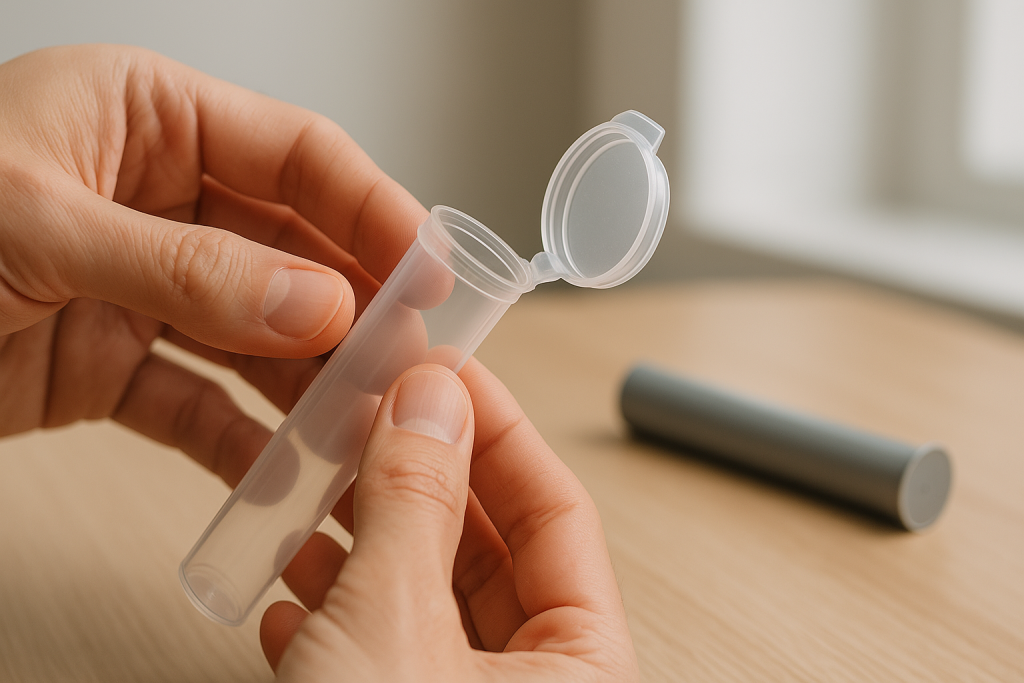
Why opening matters more than people admit
Opening a tube should feel boring. It often is not. The problems usually start with poor handling, rushed storage or the wrong pre roll tube sizes for the product inside.
When a lid sticks, people reach for teeth or scissors. That is where spills, crushed cones and split fingernails happen.
A tube is meant to protect aroma, shape and hygiene. It also has to be usable by adults.
Know the closure before you fight it
Most opening mistakes come from guessing the mechanism. Many tubes use child-resistant closures. They rely on two motions that need to happen together.
This is where pre roll tube types matter. A push and turn cap behaves nothing like a squeeze and lift lid.
If you’re not sure what you have, look for cues. Some caps have arrows. Some have pinch points. Some have a tamper ring that needs breaking first.
| Closure style | What it wants you to do | Common mistake |
|---|---|---|
| Push and turn | Press down firmly. Twist in the open direction. | Twisting without pressure |
| Squeeze and lift | Pinch the marked points. Pull up cleanly. | Pulling from the wrong side |
| Standard screw cap | Twist with steady grip. Keep the tube upright. | Overtightening after closing |
| Snap cap | Lift at the notch. Use your thumb. | Prying with metal tools |
If a cap feels wrong, stop. Check for a seal. Check for a tamper band. Don’t brute force it.
A safe opening routine that avoids the usual mess
Start with the boring basics. Dry hands beat strong hands. A slick cap is a grip problem first.
Open over a clear worktop. Keep the tube upright. A dropped pre-roll tends to crease at the filter end.
Keep children out of the room. Child-resistant doesn’t mean child-proof. That point is backed into how these packs are tested under ISO standards.
- Dry cloth or tea towel for grip
- Flat surface with good lighting
- Bin nearby for seals and bands
- Clean hands with no hand cream
Before you open anything, look for tamper evidence. Some pre roll packaging options add shrink bands or tear strips. They can snag the lid if you twist first.
Technique that works on child-resistant caps
Push and turn caps need commitment. Press down so the inner lugs engage. Then turn smoothly until you feel the thread move.
If you twist first, you polish the cap. That makes the next attempt worse.
Use your palm, not fingertips. Fingertips slip. A palm press spreads force across the lid.
If the cap has arrows, follow them. If it doesn’t, try a short turn in each direction. Don’t crank through resistance.
Squeeze and lift lids need accuracy. Find the two flexible panels. Pinch them in. Lift straight up.
If you pull at an angle, the lid binds. It feels stuck even when it’s not.
Snap caps should open at a notch. Use a thumbnail. Use a plastic tool if you must.
Metal blades are a bad habit. They also chew up the lip. That’s how you lose a proper seal.
Standard screw caps still jam. The usual cause is overtightening. Another cause is residue on the thread from oily hands.
Picking pre roll tube sizes that open cleanly
Fit affects opening more than most people expect. A packed cone can wedge against the inner wall. It can also push up into the cap insert.
Start by checking the internal clearance. Pre roll tube dimensions are not only about length. The inner diameter matters just as much.
If the pre-roll rubs the wall, you get drag. Drag becomes twist. Twist becomes a crease in the paper.
Don’t treat all formats as interchangeable. Inserts, spacers and child-resistant liners change the usable space.
If you’re comparing pre roll tube sizes across suppliers, ask what the measurements refer to. Some listings refer to outer measurements. Some refer to usable internal space.
Material also changes the feel. Rigid plastic tends to keep its shape. Softer plastics can oval slightly after pressure in a pocket or bag. That can make lids feel misaligned.
This is why pre roll container sizes should be chosen with the full pack in mind. A tight fit feels premium until someone tries to open it on a cold platform at 7am.
There are plenty of pre roll tube varieties on the market. Some have ribbed grips. Some have smooth walls for labelling. Some are designed to stand upright.
Grip texture is not a cosmetic detail. It changes how safely the cap opens.
CaliPack Pro sells Pre-Roll Tubes alongside mylar bags, jars, tamper jars and Miron jars. Tubes are a sensible pick when you want crush protection in a slim format.
Hygiene and contamination are part of safety
A tube protects the pre-roll from lint and dust. It doesn’t protect it from what’s already on your hands.
If you’ve handled food, wipe your hands first. Oils transfer to the cap. They also transfer to the paper at the tip.
Avoid dripping sanitiser onto the lid. Alcohol can leave residue. It can also affect some plastics over time.
If the tube is for CBD or regulated products, treat the outside like packaging, not a pocket trinket. Keep it off pub tables. Keep it out of the bathroom.
Storage habits that stop stuck lids
Most stuck lids are storage problems. Heat softens plastics. Cold makes some caps feel tighter. Rapid swings make condensation more likely.
Keep tubes out of direct sun. A windowsill is not storage. A car glovebox is worse.
If you’re packing products for sale in the UK, product safety still applies. Packaging has to be suitable for normal or reasonably foreseeable use. The UK Government explains that expectation in its guidance on product safety law and compliance.
Child-resistant claims should mean something. ISO 8317 sets out performance requirements and test methods for reclosable child-resistant packaging. You can read the scope on the ISO 8317 standard page.
For chemical hazard packaging, the Health and Safety Executive also summarises requirements for child-resistant closures and tactile warnings.
Don’t overtighten after closing. Stop at finger-tight. If you feel the cap jump, back off and re-seat it.
Replace damaged tubes. Cross-threaded caps don’t improve with time.
Frequently Asked Questions
How do I open a child-resistant pre-roll tube without tools?
Identify the closure first. For push and turn, press down hard with your palm. Twist smoothly until the thread releases. For squeeze and lift, pinch the marked panels. Pull straight up.
Why does my tube lid keep getting stuck?
The usual causes are overtightening, residue on the threads or a tube that has been squeezed out of round in a pocket. Temperature swings can also make caps feel tighter. Clean the rim and close only to finger-tight.
Are child-resistant tubes legally required in the UK?
Requirements depend on what the product is and how it’s classified. Some medicines packaging is assessed through the MHRA framework for packaging and labelling of medicines. For many consumer goods, the general expectation is that products placed on the market are safe under UK product safety rules.
What should I do if the pre-roll tears when I remove it?
Stop pulling straight away. Tip the tube gently into a clean palm. If the fit is too tight, switch to a wider internal diameter or use a stabilising insert that prevents sideways drag.
Can I recycle empty tubes?
It depends on material and local collection rules. Check your local guidance, then use a locator if needed. The Recycle Now guidance is a sensible starting point for UK households.