Where UK cannabis packaging is heading in 2026
In 2026, cannabis packaging in the UK is no longer just a container. It’s a selling tool plus a compliance document rolled into one. Good cannabis packaging design now has to look premium without looking reckless.
At CaliPack Pro, we see the same tension every week. Brands want impact for UK cannabis branding. Teams also want fewer headaches at dispatch plus fewer arguments with retailers.
This update is written for UK operators who sell legal CBD products plus licensed medical cannabis products. It also speaks to accessory brands that borrow cannabis cues. If you’re building packaging for anything outside UK law, stop there.

Compliance pressure is shaping cannabis packaging in the UK
UK buyers have become sceptical of packs that look like confectionery. Regulators have the same instinct. That pushes serious brands towards calmer cannabis packaging with clearer hierarchy.
If your product is treated as a medicine, you’re playing in a different arena. GOV.UK guidance on medicines packaging focuses on clarity plus patient information. It also flags child resistant packaging as a safety feature. (gov.uk)
CBD ingestibles bring their own tension. The Food Standards Agency is still policing health claims in 2026. The FSA is blunt about safety claims plus consumer confusion around effects. That reality bleeds into cannabis product packaging copy. (food.blog.gov.uk)
Then there is the boring cost pressure that now dictates material choices. Plastic Packaging Tax is £228.82 per tonne from 1 April 2026 for plastic packaging with less than 30% recycled content. That is pushing procurement teams to ask harder questions about films plus PCR content. (gov.uk)
Packaging EPR is also not optional paperwork. GOV.UK guidance sets a 1 April 2026 deadline for the next packaging data submission. Miss it then your fees become guesswork. (gov.uk)
If you ship into the EU, you also need to clock the EU Packaging and Packaging Waste Regulation application date. The European Commission states it will generally apply from 12 August 2026. UK brands shipping packs into Europe should treat that as a design brief. (environment.ec.europa.eu)
“Invisible compliance” is the look of 2026
One of the better phrases doing the rounds is “invisible compliance”. Pixels & Packs describes compliance being built into the structure. The pack still feels premium. It stops shouting about rules. (pixelsandpacks.co.uk)
For cannabis packaging, this means closures that click with intent. It means child resistant features that don’t feel like a puzzle. It also means warning panels that don’t wreck the front of pack.
Material shifts inside cannabis packaging in 2026
Material choice used to be driven by what looked loudest on Instagram. In 2026, it’s driven by barrier performance plus disposal reality. Good cannabis packaging protects aroma, moisture balance plus dosage integrity.
Coherent Market Insights values the global cannabis packaging market at USD 5.27bn in 2026. It also states the plastics segment holds the largest share in 2026. Even with all the sustainability talk, plastics still win on barrier plus cost. (coherentmarketinsights.com)
We still sell a lot of Mylar bags because they work. The change is in how brands specify them. People ask for clearer mono material paths where possible. They also ask for recycled content statements they can defend.
Kraft look, metalised shine plus the “health” cue
The UK shelf has split into two moods. One is clean kraft plus muted ink. The other is reflective film plus bold colour blocking.
Packs & Prints pushes both directions in its direct printed pouches. It highlights metalised PET for holographic shine. It also highlights kraft paper plus PET or MPET for a more natural feel. (packsandprints.co.uk)
The trick is honesty. Kraft visuals don’t make a pack sustainable. Sustainability comes from the spec plus the end of life route. Your cannabis packaging must be able to justify the claim.
Hemp packaging trends are real, yet still niche
Hemp packaging trends get a lot of attention because the story is easy to sell. Coherent Market Insights even calls out hemp plastic as a material sub category. (coherentmarketinsights.com)
In our experience, hemp based materials still need careful qualification. Barrier performance can vary. Print behaviour can surprise you. That’s fine if you test it first.
Printing and finishes for cannabis packaging design that earns its keep
Most UK buyers now know the difference between “shiny” plus “well printed”. In 2026, cannabis packaging design is judged like cosmetics packaging. If the ink rubs off, the brand looks cheap.
Pixels & Packs calls out rub plus seal failures as common boring reasons packs fail. That should worry you more than colour theory. A failed seal means returns plus complaint handling. (pixelsandpacks.co.uk)
Digital print keeps winning for short runs. Pixels & Packs points to HP Indigo for premium label work. It also mentions Xeikon for dry toner in certain applications. That matters when your pack sees oils plus constant handling. (pixelsandpacks.co.uk)

Soft touch is still popular, yet it can betray you
Soft touch finishes still sell. They also highlight scuffs. They can also look grim after a week in courier bags.
If you want premium, consider a matte base plus selective gloss. It gives contrast without a full coating gamble. Good cannabis packaging should survive fulfilment handling plus shop staff scanning.
Direct print versus label led builds
There is no single right answer. Direct print gives theatre. Labels give agility.
For brands with frequent SKU changes, we often recommend a stable base pack. Use a high quality label for variable data. That approach also supports custom print on demand workflows.
Child resistant closures that don’t feel hostile
Child resistant features are not a trend. They’re a baseline expectation in many legal markets. The design trend is usability.
Pixels & Packs makes a strong point that accessibility matters. Many cannabis consumers have arthritis plus chronic pain. Easy to open packaging improves the experience. (pixelsandpacks.co.uk)
That lesson applies to UK CBD too. If your target audience is older wellness buyers, a stubborn closure is a conversion killer. Your cannabis packaging can be secure without feeling punitive.
- Push and turn lids that don’t grind
- Child resistant zips with a clear open cue
- Tubes that don’t need fingernails to open
- Tamper evidence that doesn’t cover key text
Jars are back, especially for premium cannabis packaging
Flexible packs still dominate volume. Jars keep winning in premium. They also win when brands want a re use story with less fuss.
Pixels & Packs puts UK trade pricing on glass jars with certified child resistant lids at £0.45 to £0.75 per unit at around 10,000 units. That cost is real. It can still be worth it for higher margin lines. (pixelsandpacks.co.uk)
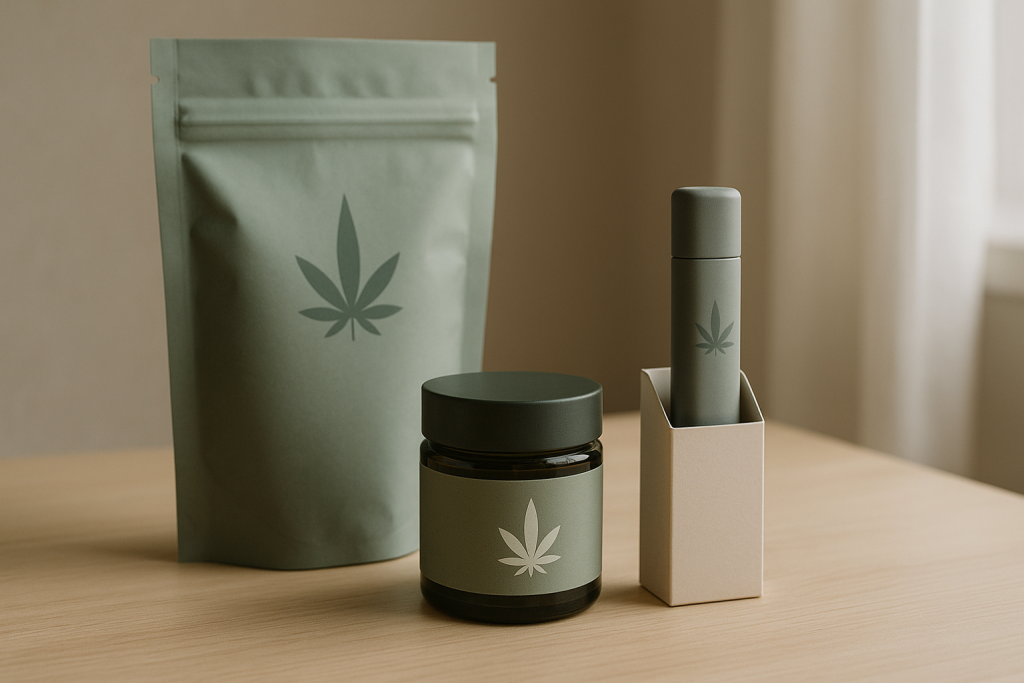
At CaliPack Pro, jars are a core part of our catalogue for a reason. We sell jars, tamper jars plus Miron jars. The point is not the jar alone. It’s the full cannabis packaging system with label space plus tamper clarity.
Why Miron jars keep getting specified
Miron violet glass is chosen for a specific retail cue. It signals “apothecary” more than “sweet aisle”. That’s helpful for UK cannabis branding that wants trust over hype.
It also reduces light exposure compared with clear glass. That helps when products are sensitive. It’s still not magic. You still need proper storage guidance on the label.

The label has become the receipt in cannabis packaging
Pixels & Packs calls this plainly. The label is where the truth lives. That’s especially true in cannabis packaging where advertising channels are constrained. (pixelsandpacks.co.uk)
Even when you’re selling CBD, retailers want batch discipline. They want shelf life clarity. They want claims that don’t wander into medical territory.
If you’re packaging licensed medical products, you also need to respect medicines norms. GOV.UK guidance keeps pushing core identifiers like batch number plus expiry date. Your pack layout should make them easy to find. (gov.uk)
THC content panels are changing pack layout expectations
Pixels & Packs argues that cannabis packaging must show THC content clearly in 2026. It frames the commercial cost of confusion. Retailers can eat returns when customers say a product is too strong. (pixelsandpacks.co.uk)
That is not just a THC issue. It’s a layout lesson. Put your key number where the eye lands. Keep it consistent across SKUs. That is cannabis product packaging discipline.
Smart features are expected, yet most are badly executed
Smart packaging is now normal talk in the sector. The reality is harsher. Many codes lead to dead pages. That makes the brand look careless.
Pixels & Packs says most retailers assume a QR code exists on cannabis packaging in 2026. The debate is what it resolves to plus whether it loads fast on shop Wi Fi. (pixelsandpacks.co.uk)
The LinkedIn trend summary from Premium Label & Packaging Solutions lists the same themes. It flags sustainable materials, premium finishes, smart packaging plus compliance first labelling. It also calls out limited run personalisation. (linkedin.com)
What smart features cost in 2026
Costs have tightened. That’s why people argue about QR versus NFC. A basic QR code is almost free. The content maintenance is the real cost.
Pixels & Packs estimates a unit level code plus verification platform adds £0.01 to £0.04 per pack in 2026. It also puts NFC inlays at roughly £0.05 to £0.12 per pack for typical short runs. (pixelsandpacks.co.uk)
If you can’t explain the payback, skip the gadget. Smart cannabis packaging should reduce counterfeits or support support tickets. It shouldn’t be brand theatre for its own sake.

Short runs, drops plus personalisation are rewriting cannabis packaging
UK retail has shifted towards drops. Cannabis adjacent brands copied that playbook fast. In 2026, short run print plus fast changeovers are not a luxury. They’re a survival tactic for cannabis packaging.
Pixels & Packs calls this out directly. It says digital print has matured for labels plus cartons. Variable data is used for batch codes plus region specific panels. (pixelsandpacks.co.uk)
That is where our catalogue splits neatly. Printed on Mylar Bags are brilliant for a consistent hero SKU. Sticker on Mylar Bags can be smarter when the range changes monthly. Jars plus pre roll tubes can use the same logic.
Lead time has become a feature
Lead time used to be a footnote. Now it’s part of the pitch. Brands want packaging that reacts to stock levels.
Pixels & Packs reports Packs & Prints selling express UK Mylar printing with a 7 to 10 day turnaround. It also references a premium economy route at around 3 weeks from artwork approval. (pixelsandpacks.co.uk)
That shift changes how you plan cannabis packaging artwork. Modular panels matter. Lock your base brand system. Swap the strain panel or flavour panel.
Pricing reality: what “marijuana packaging solutions” cost in the UK in 2026
People search for “marijuana packaging solutions” even in the UK. The legal reality is narrower. Most demand is CBD plus accessories plus compliant medical supply chains.
Pixels & Packs gives indicative UK trade prices in 2026 at around 10,000 units. A paperboard carton with aqueous coating sits at £0.18 to £0.28. A mono material PE pouch with child resistant zip sits at £0.26 to £0.40. (pixelsandpacks.co.uk)
It also gives a useful anchor for flexible. It says a solid child resistant pouch with decent print often lands near £0.32 per unit at mid volume. Add a sleeve then you add cost plus packing labour. (pixelsandpacks.co.uk)
Packs & Prints also puts visible entry prices on direct printed work. Pixels & Packs reports listings from £430.00 for certain custom printed pouches. It also reports biodegradable direct printed Mylar bag options from £577.50. (pixelsandpacks.co.uk)
| Format | Where it wins in 2026 | Typical UK trade cost signal | Common mistake |
|---|---|---|---|
| Child resistant pouch | Fast fulfilment, good barrier, light shipping | ~£0.32 at mid volume | Overclaiming recyclability |
| Paperboard carton | Premium shelf, more label space | £0.18 to £0.28 | Needing an inner pack anyway |
| Glass jar | Premium cue, reuse story | £0.45 to £0.75 | Underestimating breakage risk |
| NFC enabled pack | Authentication, warranty support | £0.05 to £0.12 added in short runs | Not maintaining the landing page |
Packaging costs are now examined through a tax lens too. Plastic Packaging Tax is a direct penalty for low recycled content plastics. In 2026 it’s £228.82 per tonne. That pushes teams towards PCR options when performance allows. (gov.uk)
How we build cannabis packaging at CaliPack Pro
We sell what UK brands actually use. That includes Mylar Bags, Printed on Mylar Bags, jars, tamper jars, Miron jars, pre roll tubes, vape bags, bundles plus custom print on demand.
Our strongest advice stays boring. Start with the product behaviour. Look at aroma, moisture sensitivity plus oil migration risk. Then pick the pack format. Only then should you argue about gloss levels.
In our experience, the best cannabis packaging is specified like a small engineering project. It has a barrier spec. It has a closure spec. It has an artwork system built for revisions.
What we ask before quoting
- Target unit count plus realistic reorder cadence
- Retail route, e-commerce route or both
- Artwork stability across SKUs
- Whether you need labels, direct print or a hybrid
We also push brands to think about data. EPR reporting plus recyclability assessment pressure is not going away. GOV.UK EPR guidance makes record keeping a normal expectation. Design teams should accept that as part of cannabis packaging now. (gov.uk)

A practical checklist for your next cannabis product packaging run
This is the checklist we use when a brand wants fewer surprises. It’s not glamorous. It saves money.
1) Lock your hierarchy. Decide what must be seen in five seconds. Potency, serving guidance plus warnings shouldn’t be fighting your logo. Pixels & Packs is clear on readability being enforced in 2026. (pixelsandpacks.co.uk)
2) Treat sustainability like an audit. Pixels & Packs says sustainability moved from brand fluff to a commercial requirement in 2026. If you can’t prove it, don’t print it. (pixelsandpacks.co.uk)
3) Pay for smart only when it fixes a problem. Codes that reduce counterfeits can earn their cost. Pixels & Packs gives added costs for serialisation plus verification. Use those numbers in your business case. (pixelsandpacks.co.uk)
4) Plan for lead time. If you need speed, design for it. Modular artwork plus label led builds help you avoid scrapping stock. Pixels & Packs cites express Mylar lead times sold in the UK. (pixelsandpacks.co.uk)
Frequently Asked Questions
What is the biggest cannabis packaging trend in the UK in 2026?
Calmer packs with clearer compliance hierarchy. Brands are still chasing premium finishes. They’re also hiding compliance in the structure rather than plastering warnings everywhere. (pixelsandpacks.co.uk)
Do UK brands need child resistant cannabis packaging for CBD?
It depends on product type plus retailer policy. Medical style expectations are rising across the category. Many brands choose child resistant formats to reduce risk plus protect brand trust.
How much does cannabis packaging cost per unit in 2026?
UK trade pricing varies by format plus volume. Indicative pricing in 2026 puts cartons at £0.18 to £0.28 with pouches often around £0.32 at mid volume for a solid child resistant build. (pixelsandpacks.co.uk)
Are QR codes still worth adding to cannabis packaging?
Yes, if the landing page is maintained for the full shelf life. Retailers increasingly expect a QR code for lab results or batch details. Dead links make the pack look untrustworthy. (pixelsandpacks.co.uk)
What does Plastic Packaging Tax mean for cannabis packaging materials in 2026?
It penalises plastic packaging with less than 30% recycled content. The rate is £228.82 per tonne from 1 April 2026. That pushes brands to explore PCR content plus material reduction. (gov.uk)
What should I prioritise for UK cannabis branding on pack?
Consistency plus legibility. Build a brand system that survives SKU growth. Put the important numbers where staff can scan them fast.
What are hemp packaging trends that matter in 2026?
More brands are trialling hemp based plastics or fibre led looks. The practical trend is still lightweighting plus fewer components. If you use hemp materials, validate barrier performance before you commit. (coherentmarketinsights.com)